Trivia 12

How do we know the Earth Rotates?

Sometimes we think to have a good argument to teach that the Earth rotates by just looking at the sky and watch the stars moving around “us” from East to West, to conclude that the Earth rotates from West to East. That is all right, but it in not a prove that the Earth rotates, it is the consequence of it. The people in the Middle Ages also saw the sky moving from East to West around them, but did not conclude from this observation that the Earth rotated around its axis (what was an axis of rotation anyway?) but thought that the universe rotated around them, announcing and proclaiming that we were the center of the universe.  In modern scientific thinking, we would take that apparent motion of the sky to hypothesize a possible rotation, but have to get the information by other means. There is a famous experiment made by Jean Bernard Léon Foucault (1819-1868). He hang on a long string (67 m) a heavy mass (28 Kg) creating a pendulum from the ceiling of the Pantheon in Paris, and with it, he was able to show how the plane of the swing motion of the pendulum was changing direction, that can only be explain if the Earth rotates. Why? Because the forces acting on the pendulum (the Tension on the string) and the force of gravity (its weight) are in the same plane; no lateral forces were acting on the mass. But because the pendulum has in motion (periodic motion) and due to the angular velocity of the rotating Earth, a fictitious force, called the Coriolis force, acts on the moving mass, making the plane of the pendulum to rotate. Illustration of this phenomenon can be seen in many science museums around the world.  The Coriolis effect can be seen on large masses that move on another body in rotation, like on Earth, and the moving masses of air determining the weather patterns. You might be wondering about the word “fictitious” force. Because, it is and effect of rotation and not a real acting force. Another fictitious force is the “centrifugal” force, that is, another effect of rotation, that in many cases are being interpreted at a reaction force of the centripetal force. Those are not action-reaction pair of forces. The Foucault pendulum is the prove that the Earth rotates (and it must do it around an axis of rotation) and now, we can use this knowledge to explain the motion of the stars around us.     

¿Cómo sabemos que la Tierra rota alrededor de su eje?

A veces pensamos que tenemos un buen argumento para enseñar que la Tierra gira entorno a sí misma alrededor de un eje, porque las estrellas se mueven de Este a Oeste, en la bóveda celeste. Esto es correcto, pero no es prueba de la rotación de la Tierra, es una consecuencia de la misma. Nuestros antepasados en la Edad Media, también observaron a las estrellas moverse de Este a Oeste, pero no concluyeron que su observación estaba basada en una rotación de la Tierra sobre su eje (¿qué significaba un eje de rotación?) pero pensaban que el universo giraba alrededor de ellos, anunciando y proclamando que eran el centro del universo. En la moderna forma del pensamiento científico, tomaríamos ese movimiento aparente del cielo para hipotetizar una posible rotación, pero que la información debería de producirse por otros medios. Hay un experimento famoso hecho por Jean Bernard León Foucault (1819-1868). Colgó de una larga cuerda (67m) una pesada masa (28 kg) creando un péndulo del cielo raso del Panteón en Paris. Con este péndulo le fue posible demostrar cómo el plano de la oscilación del péndulo, cambiaba de dirección, que solamente puede explicarse por la rotación de la Tierra. ¿Por qué? Porque las fuerzas que actúan sobre el péndulo (la tensión en la cuerda, y la fuerza de gravedad: su peso) están en el mismo plano de oscilación. Pero como el péndulo tiene un movimiento periódico, y debido a la velocidad angular de la Tierra, una fuerza ficticia, llamada la fuerza de Coriolis, actúa sobre el movimiento de las masas que están sobre el cuerpo que rota, como sobre la Tierra las masas de aire que determinan el estado del tiempo. Puede que te asombres del uso de la denotación de fuerza “ficticia”. La razón es que se trata de un efecto de la rotación y no de una fuerza real actuando sobre el cuerpo, como la gravedad u otra fuerza de acción directa. Otra fuerza ficticia es la llamada fuerza centrífuga. Centrípeta significa “hacia el centro”; centrífuga denotaría “hacia afuera”, es decir, contrario de una fuerza central. Una fuerza centrípeta es dada por la fuerza de gravedad, la centrífuga es el efecto de la rotación, que puede expresarse en términos de la velocidad angular para un observador que rota con el sistema. A veces, equivocadamente la fuerza centrípeta y centrífuga, se interpretan como fuerzas de acción y reacción. No son fuerzas de acción-reacción.  El péndulo de Foucault, puede verse en muchos museos de ciencias alrededor del mundo, y es la prueba de que la Tierra rota (alrededor de un, “su” eje), y con este conocimiento, podemos explicar el movimiento de los astros alrededor nuestro.  
Trivia 11

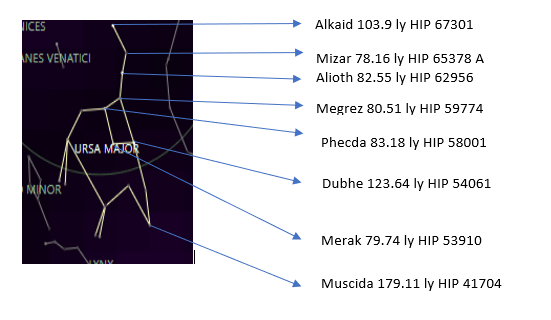
Ursa Major – Osa Mayor

The names of the Big Dipper stars are indicated in the picture by the arrows. Their respective distances from Earth are indicated in light years (ly), and the HIP Catalog numbers. You may use Stellarium for example, and in the search window write the HIP number, and the star will be pointed to you in the constellation. The Big Dipper is the asterism of the constellation called Ursa Major. Connecting visually the stars Mizar and Alkaid, and the end of the tail of the Bear, they will point towards the star Polaris. It is a good and easy way to locate Polaris.

Albert Einstein- mi idolo

Un personaje favorito para muchos es Albert Einstein. ¿Será porque era un gran físico, o porque era un filósofo de la naturaleza, profundo e introspectivo, o ambos? O, ¿será sencillamente porque aparece en tantas pancartas, fotos, pinturas y publicaciones en libros para científicos y para niños y niñas, que perciben este personaje como un inspirador de las aventuras de ciencia ficción? Albert Einstein era un extraordinario físico, pero lo considero también un gran filósofo, porque le gustaba pensar en “cosas”, cuestionar, hipotetizar, y sobre todo preguntarse ¿qué pasaría si…? Cada vez que la ciencia genera nuevos conocimientos, surgen mil preguntas más. Podemos estar muy orgullosos de las cosas que sabemos, pero también podemos estar orgullosos de disponer de un método de estudio, que nos ayuda a remover dudas y traer explicaciones para las cosas que no sabemos. La ignorancia puede removerse. Cuando aprendo algo, lo llamo ‘muy interesante’ y vivo con eso, lo acepto, mientras no pueda ‘probar’ lo contrario, mientras no tenga evidencia para alguna explicación mejor. Basado en una experiencia que Einstein tuvo cuando estaba en la preparatoria, animaba yo a mis estudiantes para que escucharan su voz interna; para que hicieran anotaciones sobre sus pensamientos e ideas, simplemente para que creyeran en ellos mismos. Einstein tenía unos padres preocupados por el rendimiento académico de su hijo, ya que sus mismos profesores les insinuaban que pensaran qué iban a hacer con él, quizá prepararlo para alguna profesión práctica con la cual podía ganarse la vida. Einstein nació en Ulm, al sur de Alemania en 1897, la época del Keiser, del imperio alemán. Era la época de la educación impartida con la metodología militar. Un estudiante tenía que ponerse de pie para contestar a una pregunta del profesor y solamente debía sentarse bajo su comando. La rígida disciplina que no funcionaba para un joven como Albert, lento y pensativo, no le ayudaba a su elástico cerebro, que no estaba para aprender de memoria sin entender. Era la época de los imperios europeos, que funcionaban bajo la disciplina militar, donde los militares obedecían, aunque tuvieran que cometer crímenes en contra de sus propios valores morales y éticos. Sencillamente un soldado obedece, no cuestiona, y eso no funcionaba con la mente de Einstein. En su época en la escuela preparatoria, una pregunta ‘simple’ lo acompañaba; algo así pasaba por su cabeza: ¿Qué pasaría si pudiera desplazarme tan rápido hasta alcanzar un fotón, y verlo junto a mí, como cuando viajo en un auto a la misma velocidad de otro de tal manera que le puedo pasar al pasajero de ese coche un vaso con agua? ¿Cómo se vería ese fotón? Pensaba evidentemente en Relatividad. Creo que tenía 16 años cuando se ocupaba de estas cosas en silencio sin atreverse a preguntárselo al profesor, o ser blanco de la burla de sus compañeros. Es lamentable que muchos estudiantes se sientan intimidados para discutir sus ideas libremente. Albert tenía una mente muy liberal, era socialista, no era comunista y detestaba un estado nacionalista. Es muy interesante el desarrollo de sus ideas físicas en una época en la cual transcurría la primera guerra mundial (evento histórico que no escribo con mayúsculas). Fue hasta después de esta nefasta guerra que Dyson y Eddington, en sus respectivas expediciones al Brasil y a la isla de Príncipe en 1919, produjeron las pruebas de la Teoría de la Relatividad General, al observar el eclipse que reveló el efecto de lo que recibe el nombre de la ‘lente gravitacional’. Einstein era un físico, que como todo estudiante en la universidad había tomado sus clases de Matemáticas para Físicos pero que, a pesar de ello, buscaba en repetidas ocasiones ayuda para dar a sus ideas la forma matemática que requerían. No era religioso, pero creo que era muy espiritual. La persona religiosa está obligada a creer en ceremonias diseñadas para convencer a otros de que creen en Dios; la espiritualidad es una relación muy profunda con la naturaleza, y la única ceremonia está en las matemáticas.  Un pensamiento espiritual de Einstein, puede ayudarnos a adquirir una idea de su perspectiva de vida:”Extraña es nuestra situación aquí sobre la Tierra. Cada uno de nosotros viene por una corta visita, sin saber por qué, sin embargo, a veces parece divinizar un propósito. Desde el punto de vista de la vida diaria, sin embargo, hay una cosa que sabemos: que estamos aquí por el bien de otros – sobre todo por aquellos sobre cuya sonrisa y bienestar depende nuestra propia felicidad, por las innumerables almas desconocidas con cuyos destinos estamos conectados por un lazo de simpatía. Muchas veces en el día, me doy cuenta cuánto mi vida interior y exterior edifica sobre el trabajo de otros, tanto vivos como muertos, y qué tan seriamente debo ejercitarme yo mismo con el fin de retornar tanto como he recibido y que todavía estoy recibiendo”. (Parcialmente citado por Dinah, Moché. Astronomy. 2004) La palabra “divinizar” ha sido traducida libremente en la red como si “fuera un propósito divino”, pero en este contexto es un verbo. Einstein no tenía una creencia en Dios como en la tradición judeo-cristiana, a pesar de que él era judío. Einstein era un pensador libre, se equivocó en varias ocasiones, y siempre estuvo dispuesto a aprender de otros y a dejar prejuicios por la verdad. No estaba atrapado en dogmas religiosos, pero era, sin lugar a dudas un ser muy espiritual. Tengo algunas cosas en común con Einstein, y el más claro es que nuestros apellidos, de origen judío, terminan ambos en ein. Pero mientras que Einstein era una roca única, yo la exhibo en mi nombre Peter.  Albert Einstein murió en Princeton, New Jersey, USA en abril 18, 1955. Yo era un niño, pero ya tenía un ídolo.

Education and Religion

It is fascinating to read in the history of the sciences how knowledge was increasing thanks to the inquisitory mind of the human being. The curiosity to understand and rationally explain natural phenomena led to the creation of a scientific methodology that responds to the way we learn. Observation is, without a doubt, the first spark that shines to unleash curiosity and seek explanations that answer to reason. But this was not the case in the past when, due to the lack of a rational methodology, the first human beings sought explanations outside nature, outside a procedure that responded to natural laws. Knowledge of these natural laws did not exist before. Without the knowledge of electricity, an electric shock must have been a mystery of the gods, and the thunder that followed the lightning was possibly the cry of a god manifesting  itself among lightning, thunder, and voices (Revelation 11.19; 16.18). This interpretation and the primitive fear of the human being were the perfect combination for the marriage of politics and religion. It came to be understood that, one needed the other to exercise dominion over people’s minds. On one occasion, Duchess Christina of Lorraine, mother of the Duke of Tuscany, had expressed concern that Galileo’s ideas were inconsistent with the word revealed by God, to which Galileo replied that the book of nature and the book of scripture could never be in conflict. This expression of Galileo became the doctrine of “the two books.”1.  Today we discover that, in modern religious fundamentalism, the Bible is understood as the first book, and the second book being nature. It’s like changing the historical order thoughtlessly. Something like putting on your shoes first and then putting on your stockings. There are modern attitudes that persist  in  trying to perpetuate religious thought.  In the struggle to impose creationism as science in schools in the United States, it had reached the point of suggesting a modification of the irrational number π, from 3,1416 to 3,000, “partly because it was simpler to use, and partly because the Bible describes Solomon’s vase as three times more  around  than  across”2 The text referred to by the author is in 1 Kings 7.23

Twenty-four years before the birth of Galileo Galilei (1564-1642), the Society of Jesus, known as the Jesuits, was founded by Pope Paul III, who dedicated themselves to rescuing the Catholic Church from weakening and possible disappearance in Europe, due to the push of the Reformation. At first the Jesuits were not for science or mathematics, or for a free exchange of ideas. Their attitude changed over time, understanding that through an educational system they could maintain hegemony and power; an educational system that could be attended by the ruling classes of the time so as not to lose them by seeking knowledge in other institutions. As Jerome Nadal S.J. suggested in 1567, saying, “For us lessons and school exercises are a kind of hook with which we fish for souls It was later that they created universities to counter the Reformation, and today they have high quality educational centers and among them there are scientists in all areas, evolving from a sect at the service of the Pope, intolerant of new ideas and whose sole purpose was to preserve the dogmas of the Catholic church. If Ignatius of Loyola were to be resurrected, he would not recognize the sect he formed in his time. Many Protestant churches have advanced educational institutions, where scientific research is done, but following in the footsteps of the origin of the Society of Jesus, whose sole purpose  was  to perpetuate  the literal and mythological interpretation of the Scriptures.  Protestants and Catholics all, we have escaped from being the center of the universe, but all our educational systems remain boats from where we throw the hook “with which we fish for souls”.

1Alexander, Amir.  Infinitesimal.  How a dangeorus Mathematical Theory shaped the Modern World.  2014.(83)

2Nelkin, Dorothy.  The Creation Controversy.  Science or Scripture in the Schools.  1982. (31)

Spanish translation.

Es fascinante leer en la historia de las ciencias cómo el conocimiento fue aumentando gracias a la constate mente inquisitoria del ser humano. La curiosidad por entender y explicar en forma racional los fenómenos naturales, llevaron a la creación de una metodología científica que responde a la forma de cómo aprendemos. La observación es, sin lugar a dudas, la primera chispa que brilla para desatar la curiosidad y buscar por explicaciones que respondan a la razón. Pero esto no fue así en el pasado cuando, por la falta de una metodología racional, los primeros seres humanos buscaron explicaciones fuera de la naturaleza, ajena a un procedimiento que respondiera a las leyes naturales. El conocimiento de estas leyes naturales no existía antes. Sin el conocimiento de la electricidad, una descarga eléctrica debía de ser un misterio de los dioses, y el trueno que le seguía al relámpago, era posiblemente, el grito de un dios que se manifestaba entre relámpagos, truenos y voces (Apocalipsis 11.19; 16.18). Esta interpretación y el temor primitivo del ser humano, eran la combinación perfecta para el matrimonio de la política con la religión. Se llegó a entender que, la una necesitaba a la otra para ejercer dominio sobre las mentes de la gente. En alguna ocasión, la duquesa Christina de Lorraine, madre del duque de Toscana, había expresado su preocupación de que las ideas de Galileo eran inconsistentes con la palabra revelada por Dios, a lo que Galileo respondió que el libro de la naturaleza y el libro de las Escrituras nunca podían estar en conflicto. Esta expresión de Galileo se convirtió en la doctrina de “los dos libros”1. Hoy descubrimos que, en el fundamentalismo religioso moderno, se entiende a la Biblia como el primer libro, siendo el segundo libro la naturaleza. Es como cambiar el orden histórico irreflexivamente. Algo así como calzarse primero y después ponerse las medias. Hay actitudes modernas que persisten en tratar de perpetuar el pensamiento religioso. En la lucha por imponer el creacionismo como ciencia en las escuelas en los Estados Unidos, se había llegado hasta el punto de sugerir una modificación del número irracional π, de 3.1416 a 3.000, “en parte porque era más simple de usar, y en parte porque la Biblia describe el vaso de Salomón como tres veces más alrededor que a través”2 El texto al que se refiere el autor está en 1 Reyes 7.23

Veinticuatro años antes del nacimiento de Galileo Galilei (1564-1642), fue fundada la Sociedad de Jesús, conocida como los Jesuitas, por el Papa Paulo (Pablo) III, quienes se dedicaron a rescatar a la iglesia católica de debilitación y posible desaparición en Europa, debido al empuje de la Reforma. Al principio los jesuitas no estaban por la ciencia o las matemáticas, o por un intercambio libre de ideas. Su actitud cambió con el tiempo al entender que a través de un sistema educativo podían mantener la hegemonía y el poder; un sistema educativo al que podían asistir las clases dominantes de la época para no perderlos al buscar conocimiento en otras instituciones. Así lo sugirió Jerónimo Nadal S.J. en 1567 al decir: “Para nosotros las lecciones y los ejercicios escolares son una especie de anzuelo con el cual pescamos por almas”1. Fue más tarde que crearon universidades para contrarrestar la Reforma, y hoy tienen centros educativos de alta calidad y entre ellos hay científicos en todas las áreas, evolucionando de una secta al servicio del Papa, intolerantes de ideas nuevas y que tenía como único fin preservar los dogmas de la iglesia católica. Si Ignacio de Loyola resucitara, no reconocería la secta que formó en su tiempo. Muchas iglesias protestantes tienen instituciones educativas avanzadas, donde se hace investigación científica, pero siguiendo los pasos del origen de la Sociedad de Jesús, cuyo único fin era el de perpetuar la interpretación literal y mitológica de las Escrituras.  Protestantes y católicos todos, hemos escapado de ser el centro del universo, pero todos nuestros sistemas educativos siguen siendo botes desde donde tiramos el anzuelo “con el cual pescamos por almas”.

1Alexander, Amir. Infinitesimal. How a dangerous Mathematical Theory shaped the Modern World. 2014.(83)

2Nelkin, Dorothy. The Creation Controversy. Science or Scripture in the Schools. 1982. (31)    

Lesson 11

Total Orbital Energy

The total orbital energy in a gravitational bound system is a constant. It will be the same calculated at aphelio as well as perihelium. The total energy will be equal to 1/2 <U> the time-average potential energy of the system. The symbol < > is an indication for the average over one orbital period. It is a result of the Virial Theorem. I will be glad to include in the lectures a demonstration for the Virial Theorem if there is a student interested in it. Contact me, and I will be glad to include a demonstration of the Virial Theorem.

The following video is the lecture for the Total Orbital Energy.

http://www.showme.com/sh?h=zvGW4Fk

Lesson 10

Starting with the fact of the Second Law of Kepler, and using the result of the Orbital Angular Momentum as a constant value in terms so the reduced mass and the eccentricity of the ellipse, the Third Law of Kepler can be shown. The square of the period of a planet is directly proportional to the semimajor axis to the third power. But this law may be used also for moons in orbit around their planets.

All is in this video

http://www.showme.com/sh?h=RfJjM5A

Trivia 9

How do we orient ourselves in the sky? In the following video I will explain that every object in the sky has an “address” given by two numbers: Right Ascension (RA) and Declination (DEC).

It is similar to how we locate cities on the Earth globe, using latitudes and longitudes, as we saw in the previous Trivia.

RA are measured in hours-minutes-seconds, and DEC are measured in degrees-minutes-seconds.

You find the video here:

http://www.showme.com/sh?h=sN7Rz3Q

Trivia 8

The Earth globe is going to help us understand how we may locate objects in the Celestial sphere. A brief review of how we locate places (cities, lakes, etc.) on the Earth, will help us. This is elementary for most of you, but a review does not hurt. The sphere is divided in two hemispheres by a great circle called the Equator. Parallel to the equatorial circle there are five more. As the circles move from the Equator to the North Pole, they a getting smaller. These circles are called parallels or lines of latitude. We will measure from the Equator to the North, North Latitudes; to the Southern hemisphere, South Latitudes. You will find the same circles drawn parallel to the Equator towards the South Pole. Between the circles there are 6 divisions of 15o each; it is just 1/4 of the whole circle: from the Equator to the Pole there are 90o. Each degree has 60′ (minutes) and each minute has 60″ (seconds). These are minutes and seconds of arc, not of time.

There are also lines of Longitude, also called Meridian lines, or simply meridians. Those lines are not parallel to each other like the latitude lines. They are traced from the north pole to the south pole. There are 24 of them. The Earth rotates around its axis in 24 hours (close enough). If we divide the equatorial circle in 24 parts, that is 360o by 24, we also get 15o between two meridians. Let me point out a very important meridian, that is the Greenwich Meridian. It is the zero meridian, from which we can count degrees, minutes, seconds to the East or West. The Greenwich meridian is the meridian that passes through Greenwich observatory in England. It goes through western France, eastern Spain, Algeria, Mali, and Ghana, before entering the Atlantic Ocean and crossing the equatorial line, or simply, the Equator. Before watching the video, try to guess the terrestrial coordinates of Lisbon, capital of Portugal.

Video: http://www.showme.com/sh?h=yrWmfEO