This lecture can be used as for college level students.
To continue with the understanding of Kepler’s laws, the presentation is a build up of the Physical-Mathematical concepts of the 2-Body problem and reduced mass. It culminated with the deduction of the total energy for the reduced mass system. The results will be used in a future lecture about the orbital angular momentum, and in a later discussion of the second and third laws of Kepler.
There are many stars in the universe that host planets; those are also solar systems like the one in which we dwell, some with more, and some with less planets revolving around the star. That does not mean that we have found life in those planets found around other stars, because they might not be suitable for developing life. Water is the major compound that we are looking for among other elements. Our star is the Sun. In this 7 min video, you can find more about the Solar System.
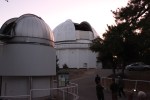
Mt. Wilson observatory in California. It shows in the back the 60″ reflector. It was in the 100″ reflector, (not in the picture) where E. Hubble convinced A. Einstein that the universe is expanding. The astronomers on the picture are walking back from the 100″ telescope, few meters away crossing the bridge where Einstein and Hubble were standing for their picture.
My name is Peter Krumbein,
I have a Licenciatura in Physics from the National Pedagogical University, Bogota/Colombia, and studied Physics at the University of Hamburg, Germany. I have a Master in Physics Education, from Andrews University, Michigan, and Master in Astronomy and Astrophysics from Valencia International University, Valencia, Spain. During 35 years I taught Physics, Mathematics and Astronomy in Colombia, Germany, Mexico, and the United States. I read every day in all subjects, specially Quantum Mechanics, History of Science, Astronomy, and many other subjects. Some of the books I recently read and recommend reading are:
1. What is Real? The unfinished quest for the meaning of Quantum Physics by Adam Becker.
2. The Planet Factory by Elizabeth Tasker
3. Infinitesimal by Amir Alexander
4. A Briefer History of Time by Stephen Hawking
5. No Shadow of a Doubt by Daniel Kennefick
Eventually I will change this list and suggest other readings that can entertain you in all times, not only in COVID-19 times.
I am a strong advocate for education, that is, for Teaching and Learning. The purpose of this site is to reach out to students at Secondary and college level, and the general public, that could profit from the lectures and information transmitted here. In the blog you will find the lectures that I am going to publish on a regular basis under the name of “Lesson for Today”, that you may reach by clicking on LECTURE. Some lectures are very basic; other presentations are more for advanced students interested in some mathematical understanding about the many areas of the sciences of Physics and Astronomy. One section where you can learn new stuff is in TRIVIA. There you will find something new to learn, and that I am learning as well. We are a community of learners, and believe it or not, I have been learning a great deal about how to set up a webpage like this one. Welcome!
I appreciate any comments that may be posting in the contact.
The classroom environment at Stratford allows your childs’ educators to give them the time and attention that they need in order to succeed. We believe in keeping class numbers low to maximum learning potential.
Fantastic Facilities
Each student has access to the best possible learning technologies, as well having guest classes from industry professionals. We believe this better prepares your child for their careers or own businesses.
Life Long Learning
We believe in equipping your children with the skills to be able to learn for the rest of their lives! By instilling in them a method of analytical thinking, we believe they will be able to be independent thinkers and be high performers in their chosen careers.
What other parents say
My son struggled with mathematics during his school years – until we enrolled him at Stratford. That has been the best decision we made, and his educators have worked hard to get his mathematics to a level we never thought possible!
― Anthony, Grade 8 parent
My daughter has loved being at Stratford for the last 5 yeras. The learning environment makes the difference and I’m so proud that she has been accepted into University next year!
― Megan, Grade 12 parent
Our Success
1500+
Since we opened in 2017 we’ve seen the lives changed of over 1000 students.
100%
If our students don’t succeed, then we haven’t done our job. Our students have a 100% University acceptance rate!
5
Year on year we have consistently produced the results you are looking for for 5 consecutive years.
Still not Satisfied?
Why not set up an assessment for your child where they will interact in a real classroom environment?
We will spend a day with your child in one of our classroom, where they will get to see what a day in the life of a Stratford student is like. Get in touch with us and we can help your child fulfil their potential by enrolling at Stratford!
As we commonly know, rocks are classified as igneous rocks, metamorphic rocks, and sedimentary rocks. Igneous rocks are rocks that have been melted, and are formed when a hot molten rock cools, from magma. These rocks melt in the upper mantle of the Earth and below the crust. The igneous rocks are rich in minerals mainly silicates, like feldspars, that are silicates of aluminum, or potassium (alkaline feldspars) or rich in sodium and calcium like in the plagioclase feldspars. This magma that moves upwards towards the surface of the Earth in the mantle could cool underground, forming intrusive rocks, and when magna, like after expelled by a volcano, is lava that will form extrusive rocks. The molten rock will solidify in different ways, depending on the rate of loss of heat. The magma in the mantle and deep in the crust, will cool down much slower that the lava that comes out from a volcano; this rate of cooling will give rocks different forms and structure. If the cooling is very fast, it can produce rocks that look like glass with no crystal forms, like obsidian.
Metamorphic rocks are modified by high temperature and pressure do to the forces acting on the crust, and the interior of the Earth. These rocks are chemically combined with many ingredients that are then given the names to these rocks accordingly, like marble, gneiss and slate, for some examples.
Sedimentary rocks are the result of the erosion by water (rain, ice) and air (winds). These can only happen in planets that have an atmosphere were winds can form, and flowing water that can transport the rocks over the surface. Shale and sandstone are the most abundant sedimentary rocks on the surface of the Earth, in a proportion of 70% shale and 20% sandstone.
But what about primitive rocks? These rocks were not transformed inside planets by pressure and temperature changes as we just read for the igneous and metamorphic rocks. There primitive or original rocks are common in asteroids and what we can see in the meteorites.
Geologists also teach us about breccias, rocks that are broken that show sharp edges glued together by high temperature and pressure, but not from the interior of the Earth, but from impacts that can be discover in the interior of craters.
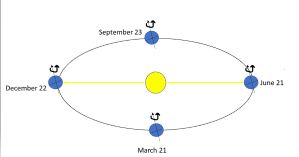
Have you ever thought about the reason why, when we have in the northern countries, like in the USA and Canada, and the countries in Europe, cold winter season, and in South America, like in Argentina and Chile during the same time a warm summer? First, we need to remove the idea that it is because of the distance to the sun. Actually, yes, during the summer in the northern hemisphere we are closer to the sun, but it is not only the northern hemisphere that is closer to the sun, it is the whole Earth that is closer to the sun, during the summer in the north. But why is it summer in Argentina or in Australia, and in the Northern Hemisphere cold winter? It has to do with the inclination of the Earth axis of rotation. The axis of rotation will always point toward the northern star, Polaris. The Earth will not point to another star while revolving around the Sun. Because of that, the Sun will have an apparent motion between the southern hemisphere to the northern hemisphere passing the Equatorial line. The Sun describes a curve in the sky that is called the ecliptic, and when the ecliptic cuts the Equator on March 21, we call this point the Venal Equinox. This is the point when the day and the night have equal lengths. In the picture you can see how the sun is sending more warm rays to the north in June, and less to the south, and in December is the opposite. Just the axis of inclination!
Note the yellow Sun rays on December 22 warming up the Southern hemisphere, and on June 21 the Northern one.
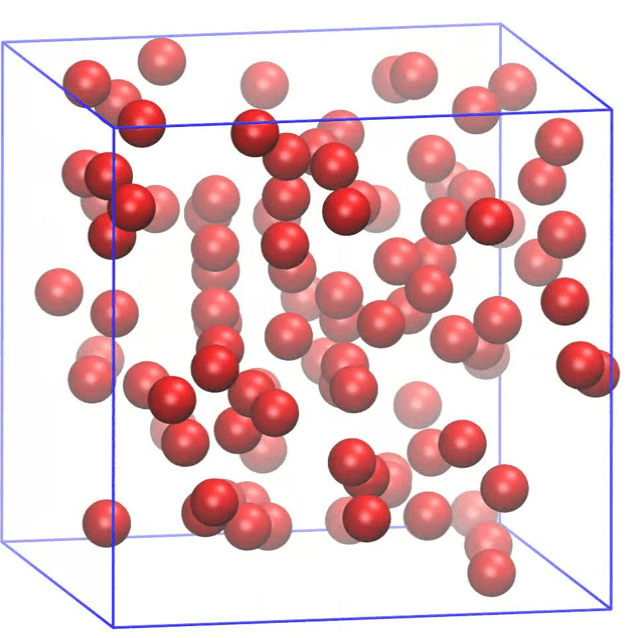
The states of matter depend on how the average distance between their molecules is compared with the size of the molecules themselves. In a gas, the molecules are separated in average by distances much larger than the molecules sizes. There are, as we know, substances in solid state at normal temperature and pressure. Their molecules are not individual isolated units like in the gaseous state. The separation of the molecules in a solid state can be considered in the order of the size of the molecule itself, and the force that keep the molecules together are of the same magnitude as the strength of the forces that keep the atom in the molecule together. This is typical os solids that present a crystal lattice formation.
How do Planets, or other objects move around a star? The observations of the German astronomer, Johannes Kepler (27 December 1571 – 15 November 1630), deduced the three laws that are being used today to answer that question. I will describe the three laws in three different lessons, starting today with the first one below.
First law. Allplanets describe an elliptical trajectory around the Sun (star), while the Sun is placed in one of the focus of the ellipse. Contrary to the circle that has one center point, the ellipse has to points that characterize it; those points are called each a “focus” (plural foci). Therefore the ellipse looks more like an oval, and not like a circle. If you want to know more of the ellipse, click in the link below.
The distance from a particle (or a planet) to the Sun, is measured in terms of the semimajor axis of the ellipse traced by that body around the Sun. According to Kepler’ law, the square of the period (time that the body takes to go once around de Sun in years) is directly proportional to the cube of the semimajor axis, in Astronomical Units. The Astronomical Unit by definition is the semimajor axis value (in A.U.) for which it takes 1 year to revolve around the Sun. That means actually that the distance from the Earth to se Sun is larger that one A.U. The difference is small and negligible though. We take then 1 A.U. = the distance from Earth to the Sun. It is close to 150 million kilometers.
If you like to watch the math explanation for this lesson, you may click on this link


 AstroDidactics