Trivia 7

From the illustration in Trivia 6, you must have gotten the idea that all what we see, is above the horizon. Wherever you live, you have your own horizon. Imagine a person 1.7 m tall, lying somewhere on the Earth that has a circumference length of 40,074 kilometers. That person has covered a surface of 0.0004% of the length of the circumference around the Earth. It would be necessary to have 24 million people lying on the equator to trace the circumference of the Earth.

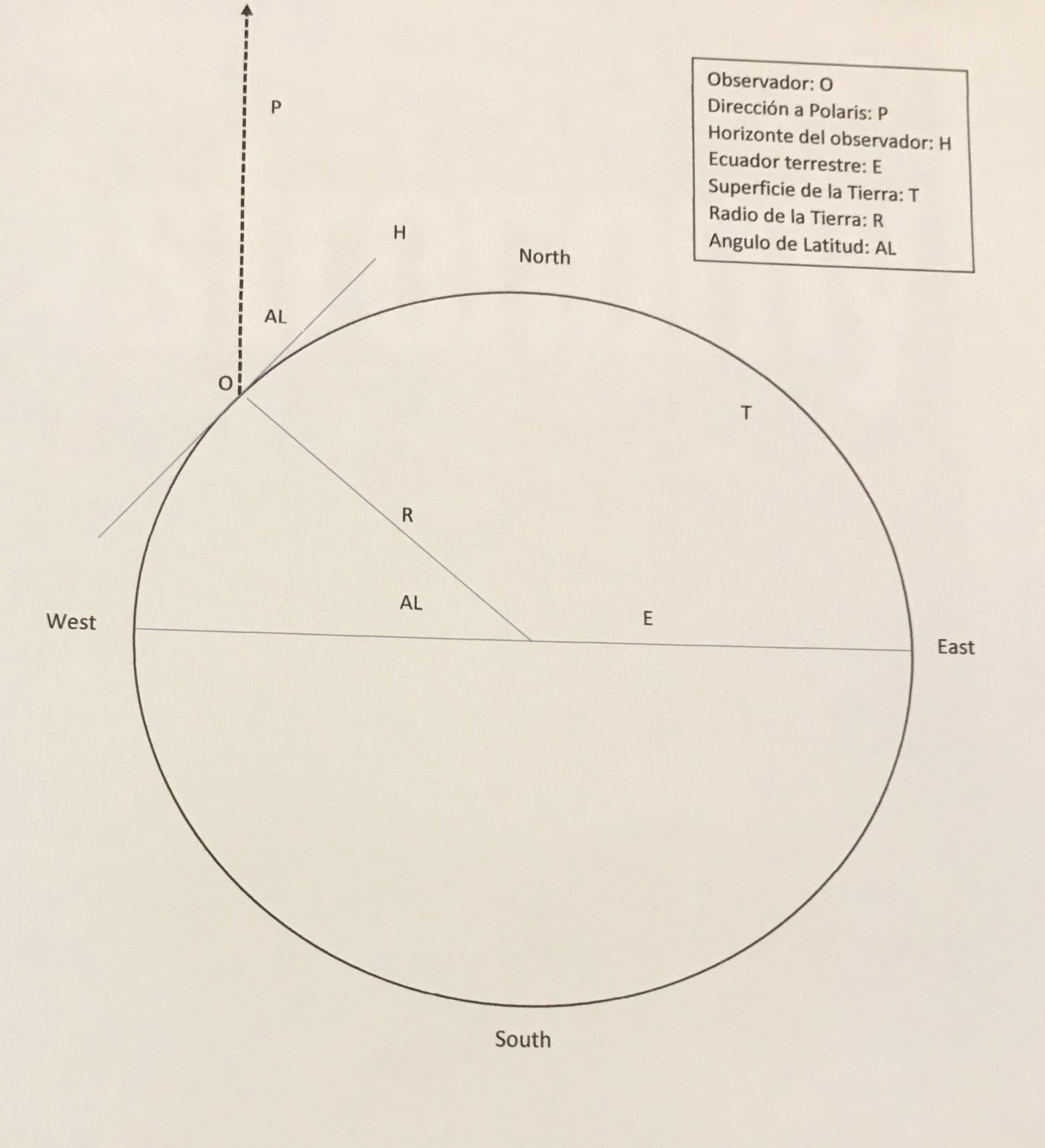
In the picture above, H is the horizon where you are standing as an observer O, at a latitude angle AL. Notice the latitude in this illustration is North, indicated by the Radius R of the Earth and the Equator E. The direction P indicate that you looking at the polar Star, Polaris. The angle of your latitude is also the angle formed by the horizon line and the direction to Polaris. The celestial equator is perpendicular to the dotted line in direction to Polaris. Recall from the illustration in Trivia 6, the Zenith is directly above you, perpendicular to the horizon. This indicates that the prolongation of the Radius of the Earth at your observing site, is the Zenith. The angle between the Zenith and the dotted line to Polaris is 90o – AL. Practically speaking, that would be the angle you will find by stretching one arm towards Polaris, and the other arm towards the Zenith. If you have a telescope, point it to Polaris; the angle the telescope makes with the “ground” (your horizon) is the same as your home latitude. The opposite direction of your telescope will be perpendicular to the equatorial circle, which is the maximum circle around the Earth that divides North and South.

In the next Trivia, I will show you how to locate celestial objects using the celestial coordinates. Stay tune.
Trivia 6

We can only see above the horizon, day or night. During the night sky observation, we see the stars above our horizon. Let us define some terms, for those of you who want to get oriented in the sky, and are doing it for the first time.

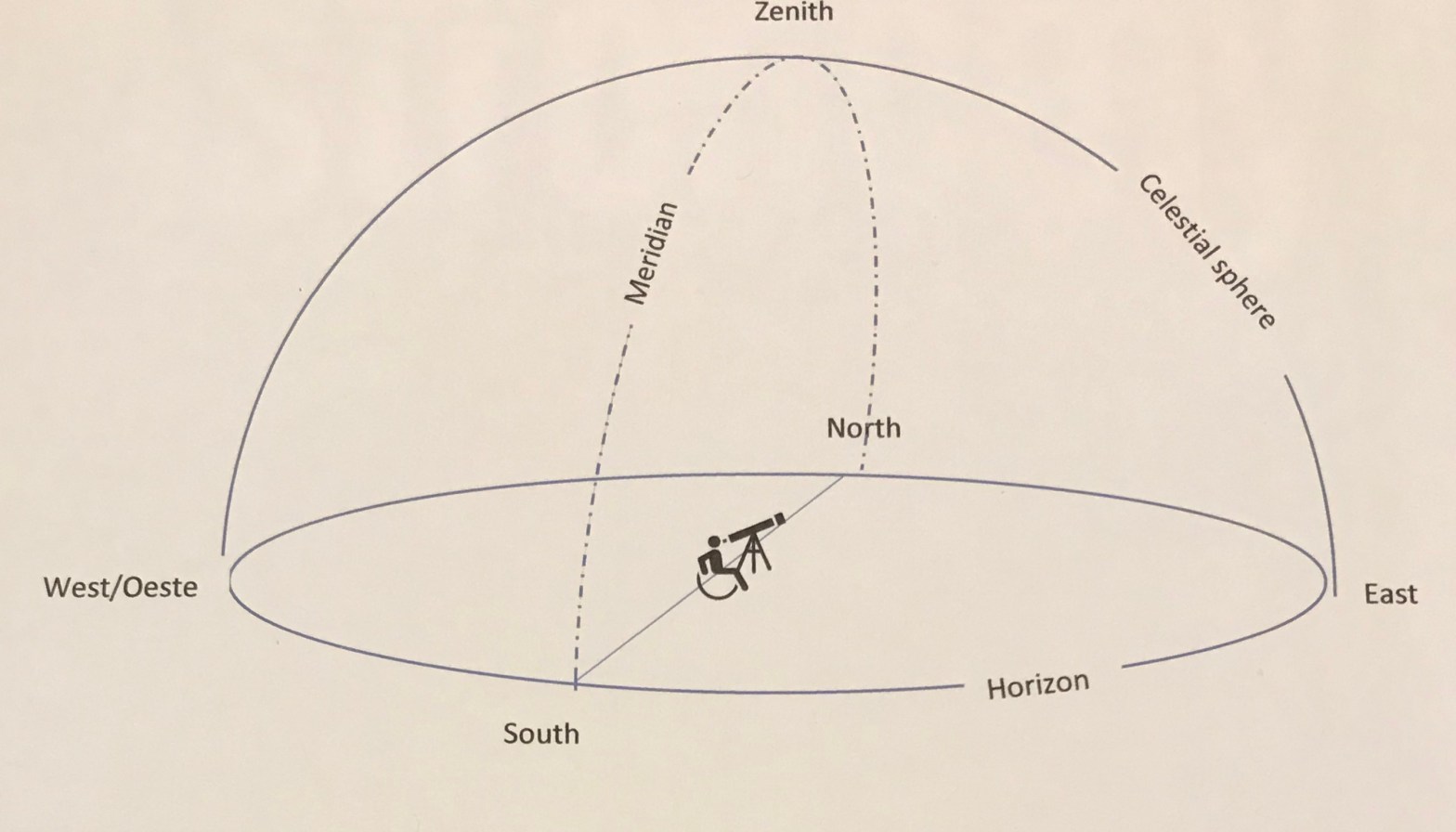
With the help of a compass, you can locate the North-South direction. You then can face North or South. Now look up, directly above you, that is the zenith of the celestial sphere. Yes, we feel like a chicken under a wire concave lid, and the zenith is the ring to lift it. If you trace with your extended arm an imaginary line above your head from North to South, you are tracing your Meridian. You will see the celestial sphere “moving” with all the stars from East to West. The stars are so far away that we do not perceive their motions (they are moving!), but we see them in a relative motion with respect to the Earth, as it moves from West to East in its daily rotation. We perceive the sky moving from East to West. The celestial objects are going to transit form East to West your celestial meridian. When the stars are exactly on your meridian, we say they that the star culminates; that indicates that the object has reached is maximum altitude.

Trivia 5

Constellations are patterns of stars that can be recognized in the sky. Surely you are acquainted with the constellations of the zodiac, the ones that appear in the ecliptic: Pisces, Aries, Taurus, Gemini, Cancer, Leo, Virgo, Libra, Scorpius, Sagittarius, Capricornus, and Aquarius. This 12 constellations were recognized in the nocturnal sky since ancient times, and are even today, somehow invoked by astrologist and people who believe, that the stars are part of the destine of human kind. The International Astronomical Union has recognized officially 88 constellations. Cassiopeia, the Queen is one in the northern latitudes, that can be recognized for its form of a w. Orion, the Hunter, is a beautiful constellation that you will recognized as three stars in line, framed by four stars, two of which are Betelgeuse and Rigel. There are much more stars in a constellation that we cannot see with our unaided aye, but the pattern we recognize is called an asterism.

I encourage you to download in your computer a very good informative interactive star map, like Stellarium. It looks like shown in the picture. You will have a great deal of joy and satisfaction learning and watching the sky with this program.

Lesson 7

In this video you will follow up with the Orbital angular momentum-continuation from last lecture. The presentation is made in Spanish. I was taping the presentation in Spanish, and after I realized it was already advanced that I decided to finished it in Spanish language. So, but an English speaking person can follow it also. It starts with a review of the result of last lecture that ended with the result that the angular momentum is a constant in a closed orbit like an ellipse. This lecture ends with an expression for the angular momentum in terms of the eccentricity.

http://www.showme.com/sh?h=oAjV5Bg

Lesson 6

The Orbital Angular Momentum

The orbital angular momentum is a very important concept that has physical consequences for a body revolving around another, like planets around the stars, or moons around the planets. In this lesson, we are exploring what the orbital angular momentum is, and developing an expression for the one problem body problem of reduced mass. Click on the video to follow the lesson.

http://www.showme.com/sh?h=yM7HXt2

Inspiration for scientists

Reading from the book of Michael White, Isaac Newton-The Last Sorcerer-p.82 at start of chapter 5, I found the following inspirational reflection of Werner Heisenberg.

“It is probably true quite generally what in the history of human thinking the most fruitful developments frequently take place at those points where two different lines of thought meet. These lines may have roots in quite different parts of human culture, in different times or different cultural environments or different religious traditions: hence if they actually meet, that is, if they are at least so much related to each other that a real interaction can take place, then one may hope that new and interesting developments may follow”.

Lesson 5

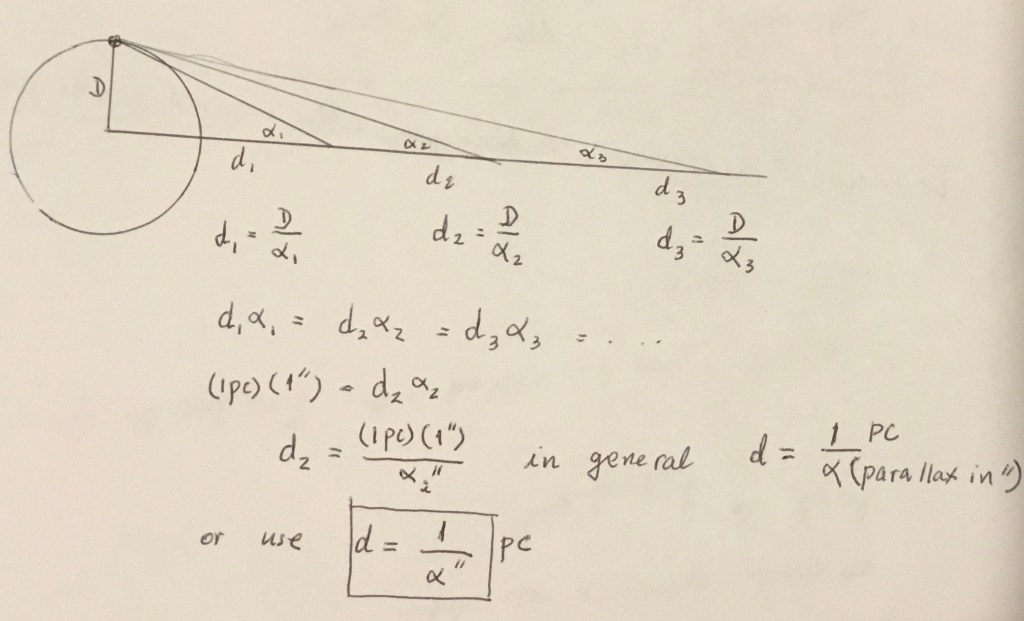
In the literature we find that, to calculate the distance in parsecs (pc) to a particular star, we need to know the parallax angle in seconds of an arc, and determine the reciprocal of it. The question I would like to explore in this lesson is, the why do we do this. Look at the picture below, and you will realize that the further away the star is, the smaller is the angle alpha of parallax.

For each different observation using tis method, the product of the distance and the corresponding angle of parallax found, is a constant, which is 1 A.U.

For example, for the bright star Sirius A (Binary star of magnitude -1.44), it is found a parallax angle of 0.379″ (sometimes given tables give the parallax angles in milliarcsecond, mas).

The distance is found to be d=1/0.379 = 2.639 pc.

2.639 pc x 3.26 l-y/pc = 8.58 l-y, and we see this star as it was 8.6 years ago.

Lesson 4

In Lesson 1 you can follow the definition of the Astronomical Unit based on a “test” particle, that takes to revolve around a major body, exactly one year. We saw, that based on this definition, the Earth’s distance from the Sun is slightly smaller, compare with the test particle’s distance around the Sun. The result is, that with a good approximation, the Astronomical Unit can be given as 150,000,000 kilometers, and we write this is ‘scientific notation’, considering the number to large to write many zeros. We write then 1.5 x 10⁸ km. But this distance, as big as it may seem to be, is small for the dimensions of our Galaxy, the Milky Way, and much no viable to use in the universe. It would be like giving the height of a building in millimeters. Astronomers use units that are more suitable for the description of the Universe.

In the following video, I will describe the light-year (l-y), and the parsec (pc).

Because the expression “light-year” features the word “year”, let’s clarify that this unit is not a unit of time. We have to read the whole expression as “light-year”, not as “year” only. A light-year is a unit of distance. It is by definition, the distance light travels in one year, at a speed close to c=3×10⁸ m/s (meters/second).

Watch the following video for the definition of a parsec.

http://www.showme.com/sh?h=fAJ93w0